The Last Weeks of Abraham Lincoln by David Alan Johnson
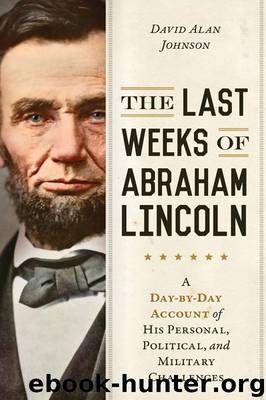
Author:David Alan Johnson
Language: eng
Format: epub
ISBN: 9781633883987
Publisher: Prometheus Books
APRIL 7, 1865.
Lieutenant General U. S. GRANT,
Commanding Armies of the United States:
GENERAL: I have received your note of this date. Though not entertaining the opinion you express of the hopelessness of further resistance on the part of the Army of Northern Virginia, I reciprocate your desire to avoid useless effusion of blood, and therefore, before considering your proposition, ask the terms you will offer on condition of its surrender.
R. E. LEE,
General.14
“That was not satisfactory,” was General Grant's reaction to Lee's reply.15 But he had not really expected General Lee to surrender on the basis of one letter. Still, he considered General Lee's reply “as deserving another letter,” and decided to send him another surrender request in the morning, after he had a few more hours sleep.
President Lincoln did not know anything about Grant's letter to Lee, or about Lee's reply. The president would be making a return visit to Petersburg that day, and was more than preoccupied with the trip. Mary Lincoln had not seen Petersburg; she had been in Washington when the president made his first visit to the city, and she wanted to visit it before returning to Washington. The president decided to accompany her and her party. Mrs. Lincoln's group would include Tad, Senator Charles Sumner, Elizabeth Keckley, and the Marquis de Chambrun. They would travel by train from City Point, and were on their way by noon.
Julia Grant had not been invited to join the Lincolns on their journey, and was offended by the exclusion. “I saw very little of the presidential party now,” she wrote, “as Mrs. Lincoln had a good deal of company and seemed to have forgotten us.”16 “I felt this deeply and could not understand it,” she said many years later. One possible explanation for Mrs. Grant's exclusion from the president's party was Mary Lincoln's embarrassment—she was still suffering from humiliation over her behavior regarding Mrs. Ord at the end of March. Even though the incident had taken place almost two weeks earlier, the president's wife was probably still too ashamed to face Julia Grant.
The train ride to Petersburg was ordinary and uneventful—entirely too ordinary and uneventful to suit the Marquis de Chambrun. Even though President Lincoln was the focal point of the journey—“we grouped ourselves around him”—the marquis pointed out that the president rode “in an ordinary day-car” along with a few unidentified officers and “several Negro waiters” from the River Queen.17 This struck the marquis as not only unusual but also improper. In France, such a high-ranking government official would have his own private carriage, which would have been elegantly and lavishly decorated and would have been reserved for himself and members of his family. But President Lincoln rode in an ordinary, plebian “day-coach,” which he deigned to share with officers and Negro waiters—the marquis referred to these passengers as “intruders.” Instead of elegance, Lincoln apparently preferred plainness and simplicity, which the marquis found impossible to fathom.
This fondness for straightforwardness was one of the reasons behind President Lincoln's admiration for
Download
This site does not store any files on its server. We only index and link to content provided by other sites. Please contact the content providers to delete copyright contents if any and email us, we'll remove relevant links or contents immediately.
| Africa | Americas |
| Arctic & Antarctica | Asia |
| Australia & Oceania | Europe |
| Middle East | Russia |
| United States | World |
| Ancient Civilizations | Military |
| Historical Study & Educational Resources |
Cat's cradle by Kurt Vonnegut(15365)
Pimp by Iceberg Slim(14522)
4 3 2 1: A Novel by Paul Auster(12403)
Underground: A Human History of the Worlds Beneath Our Feet by Will Hunt(12101)
The Radium Girls by Kate Moore(12035)
Wiseguy by Nicholas Pileggi(5795)
The Fire Next Time by James Baldwin(5454)
Perfect Rhythm by Jae(5411)
American History Stories, Volume III (Yesterday's Classics) by Pratt Mara L(5312)
Paper Towns by Green John(5195)
Pale Blue Dot by Carl Sagan(5013)
A Higher Loyalty: Truth, Lies, and Leadership by James Comey(4966)
The Mayflower and the Pilgrims' New World by Nathaniel Philbrick(4508)
The Doomsday Machine by Daniel Ellsberg(4493)
Killers of the Flower Moon: The Osage Murders and the Birth of the FBI by David Grann(4451)
The Sympathizer by Viet Thanh Nguyen(4398)
Too Much and Not the Mood by Durga Chew-Bose(4353)
The Borden Murders by Sarah Miller(4330)
Sticky Fingers by Joe Hagan(4207)
